
When Debate Becomes Identity
How Adversarial Thinking Creates the Conflicts It Claims to Resolve

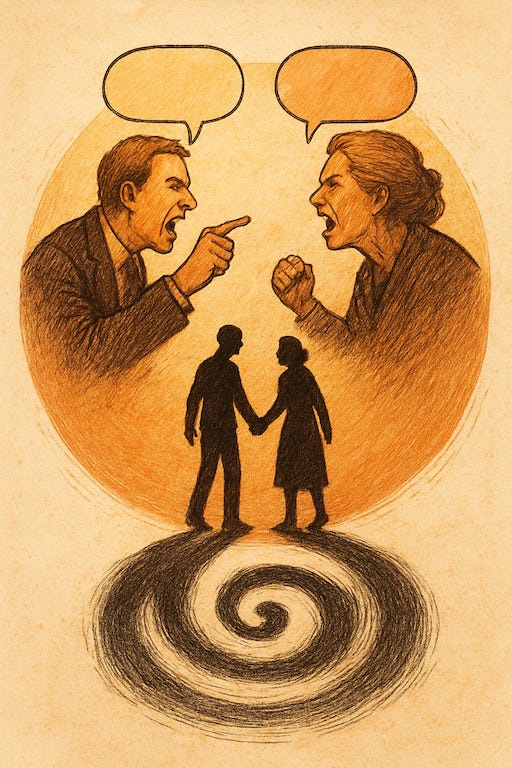
When Debate Becomes Identity
How Adversarial Thinking Creates the Conflicts It Claims to Resolve
by Terry Cooke-Davies
I’ve been writing about debate as a consciousness trap - how our institutionalised adversarial thinking prevents us from addressing complex challenges. But there’s something darker here, something I’ve watched play out over forty-five years of facilitation work across three continents.
Debate doesn’t just fail to resolve conflicts. It creates them.
Not metaphorically. Not just intellectually. Actually creates the conditions for social division, tribal warfare, and ultimately physical violence.
Let me explain how.
The Pattern: From Position to Identity to Enemy
Here’s what I’ve observed happening, again and again, in organisations, communities, and nations:
Step 1: Debate forces you to take a position
The structure of debate requires it. You can’t participate without choosing a side. For/against. Yes/no. This proposal or that one. The format demands binary choice.
So far, so obvious. But watch what happens next.
Step 2: Position becomes identity
Once you’ve publicly defended a position - especially if you’ve done so skilfully, especially if others were watching, especially if there were stakes involved - something shifts.
The position stops being “a view I currently hold, subject to revision based on new information.” It becomes “who I am.”
“I am pro-life.” “I am a climate activist.” “I am a free market advocate.” “I am a defender of traditional values.”
The position gets woven into your sense of self. Your tribe recognises you by it. Your status depends on defending it well. Your belonging requires you to maintain it.
Step 3: Identity requires enemies
This is where it gets dangerous, and where René Girard’s anthropological work becomes essential.
Girard spent decades studying how human communities form identity, and what he discovered was unsettling: we don’t primarily learn who we are through positive self-definition. We learn who we are through opposition.
We know ourselves by knowing what we’re against. We define our group by defining who’s not in it. We strengthen our bonds by identifying common enemies.
This isn’t conscious malice. It’s how human identity has worked for millennia. As Girard showed, mimetic desire - learning what to want by imitating others - inevitably creates rivalry. And rivalry, left unchecked, escalates toward violence.
Step 4: Enemies justify conflict
Once you’ve identified as fundamentally opposed to another group, once they’ve become not just “people who disagree with me” but “threats to everything I stand for,” violence becomes thinkable.
Not immediately. Not inevitably. But the ground is prepared.
First comes rhetorical violence - the dehumanising language, the apocalyptic framing, the existential stakes. Then social violence - exclusion, shunning, professional destruction. Then, under certain conditions, physical violence.
Debate culture doesn’t cause all violence. But it creates the identity structures that make violence feel justified, necessary, even righteous.
The Anthropological Evidence
This isn’t speculation. It’s pattern recognition based on both scholarly work and lived experience.
Girard and Mimetic Violence
René Girard’s anthropological research revealed that human cultures have always struggled with what he called “mimetic crisis” - the moment when rivalries escalate toward violence that threatens to destroy the community.
His insight was that traditional cultures developed elaborate mechanisms to manage this: ritual, sacrifice, and most importantly, the designation of scapegoats. By focusing collective violence on a single victim, communities could discharge accumulated tension and restore temporary peace.
James Alison, the theologian who introduced me to Girard’s work, helped me see how Christianity was meant to break this cycle - not by providing another sacrificial system, but by revealing the innocence of the victim and making scapegoating visible and thus unsustainable.
But here’s what’s relevant for our discussion: modern debate culture recreates the very mimetic dynamics that ancient rituals tried to manage. It structures rivalry. It encourages imitation of desire (everyone wants to win). It designates losers who can be legitimately excluded. And it sanctifies the process as “rational discourse.”
We’ve taken the violence out of the ritual whilst keeping the identity-formation mechanism intact. Or rather, we’ve told ourselves we’ve taken the violence out, whilst actually just displacing it.
Bateson and the Ecology of Mind
Gregory Bateson, who moved between anthropology, cybernetics, and systems thinking, understood something crucial: the structure of communication shapes the structure of relationship, which shapes the structure of society.
In Steps to an Ecology of Mind, Bateson explored how symmetrical relationships - those based on competition and matching - naturally escalate. When my move requires your counter-move, which requires my escalation, which requires your further escalation, we’re caught in a pattern that can only end in breakdown or breakthrough.
Debate is quintessentially symmetrical. Every argument requires counter-argument. Every position demands opposition. Every move calls for escalation. The structure itself drives toward crisis.
What Bateson called “schismogenesis” - the progressive differentiation of groups through cumulative interaction - is precisely what happens when debate becomes the dominant mode of political and social engagement. Groups become more and more different from each other, more and more opposed, until the gulf becomes unbridgeable.
Whitehouse and Ritual Cohesion
Harvey Whitehouse’s anthropological work on ritual and social cohesion reveals how shared intense experiences create “identity fusion” - the merging of personal and group identity that makes people willing to die (and kill) for their community.
What Whitehouse discovered is that it’s not primarily shared belief that binds groups together with such intensity. It’s shared ordeal, shared threat, shared triumph over enemies.
Modern political movements increasingly understand this. They create the experience of embattlement. They manufacture crises that require collective response. They celebrate victories over opponents as tribal bonding moments.
And debate culture provides the perfect structure: regular rituals (elections, parliamentary sessions, media confrontations) where your side faces off against their side, where winning feels like survival and losing feels like existential threat.
Tett and Anthrovision
Gillian Tett, in Anthrovision, shows how anthropological insight can illuminate contemporary institutional dysfunction. Her work reveals how cultures we think we understand - corporate cultures, financial cultures, political cultures - operate according to hidden logics that become visible only when we step outside our own assumptions.
What an anthropological lens reveals about modern debate culture is this: we think we’re engaging in rational discourse, but we’re actually performing tribal identity. We think we’re resolving disagreements through better arguments, but we’re actually creating and maintaining the boundaries that define who “we” are versus who “they” are.
The very institutions we’ve built to manage disagreement peacefully - parliaments, courts, universities, media - have become engines of identity formation through opposition. They don’t resolve conflicts. They ritualise them, sanctify them, and make them constitutive of social order.
How I’ve Watched This Play Out
Over forty-five years of facilitation work, I’ve seen this pattern emerge at every scale.
In organisations: Teams split into factions around a strategic decision. Positions harden into identities. “We’re the innovative ones.” “We’re the ones who care about quality.” “We’re the practical realists.” Soon they’re not just disagreeing about strategy - they’re defining themselves against each other. Trust collapses. Collaboration becomes impossible. Sometimes the organisation splits or implodes.
In communities: A local issue - development plans, school policies, environmental concerns - gets structured as debate. People take sides. Positions become tribal markers. Neighbours stop speaking. Relationships spanning decades shatter. The original issue becomes secondary to the identity conflict it generated.
In nations: Political debate creates identity categories that feel as essential as ethnicity or religion. “We’re conservatives.” “We’re progressives.” Soon you can predict someone’s entire worldview from a single position. You know who they vote for, what media they consume, who they consider legitimate, who they see as enemy. The debate structure has created comprehensive tribal identities.
Between nations: Geopolitical “debates” about interests, territories, and ideologies become identity conflicts between civilisations. “We’re the free world.” “We’re the authentic culture.” “We’re the future.” Once locked into these identities, compromise becomes betrayal. Negotiation becomes weakness. Violence becomes defence of who we fundamentally are.
At every level, the same pattern. Debate structures rivalry. Rivalry generates identity through opposition. Identity requires enemies. Enemies justify violence.
The Girardian Crisis of Our Moment
Here’s what makes our current situation particularly dangerous: we’ve globalised debate culture through digital media whilst simultaneously fragmenting into countless micro-identities, each defined against all the others.
Social media platforms are perfectly designed to accelerate mimetic crisis. They:
Force public position-taking on every issue
Reward extreme positions with engagement
Make disagreement visible and perpetual
Create audiences that witness and judge your consistency
Punish deviation from group orthodoxy
Provide constant streams of enemies to define yourself against
The algorithm doesn’t just show you content. It shapes you into an identity-through-opposition, continuously feeding you reasons to believe your group is righteous and under threat.
Girard’s insight was that mimetic crisis escalates until it finds a scapegoat - a victim whose sacrifice allows collective tension to discharge. Traditional cultures had rituals to manage this. Modern cultures have... what, exactly?
We’ve told ourselves that rational debate and democratic processes would allow us to manage difference peacefully. But we’ve actually created conditions for perpetual low-level mimetic warfare, punctuated by explosive violence when tensions become unbearable.
The January 6th Capitol riot. Sectarian violence in India. Increasing political assassination attempts. Rising hate crimes against designated out-groups. These aren’t aberrations. They’re the logical endpoint of identity-formation through adversarial opposition, playing out at scale.
Why This Matters for Complex Challenges
Climate change doesn’t care about our identities. Neither do pandemic diseases, ecological collapse, or technological disruption. These challenges affect everyone and require collective intelligence that transcends tribal boundaries.
But we’ve structured our entire approach to these challenges through debate. Which immediately transforms them into identity conflicts.
Climate becomes “environmentalists vs. climate deniers.” Technology becomes “progressives vs. traditionalists.” Public health becomes “freedom defenders vs. safety advocates.”
Once framed as identity conflicts, these challenges become unsolvable. Because solving them would require the “losing” side to surrender not just their position but their identity. Which feels like death. Which they’ll resist with everything they have.
This is why we can have overwhelming scientific evidence for climate change whilst political action remains paralysed. It’s not an information problem. It’s an identity problem. People aren’t defending their beliefs about atmospheric CO2. They’re defending who they are.
This is why pandemic response fractured along tribal lines despite the virus affecting everyone equally. Public health measures became identity markers. Wearing masks became tribal signifiers. The virus didn’t care. But our debate-structured identities did.
The Violence Hiding in Plain Sight
When I say debate creates violence, I don’t just mean the occasional riot or assassination.
I mean the structural violence of:
Political systems that render entire groups invisible or illegitimate
Economic debates that treat human suffering as acceptable collateral damage
Media ecosystems that profit from perpetual outrage
Educational systems that train analytical aggression whilst atrophying empathy
Social networks that reward tribal performance over genuine understanding
I mean the everyday violence of:
Families fractured by political identity
Friendships destroyed over position-taking
Communities unable to collaborate across difference
Generations unable to understand each other
Humans increasingly unable to see each other as human
And I mean the violence we do to ourselves:
The constant vigilance required to maintain ideological purity
The exhaustion of perpetual opposition
The narrowing of curiosity to only what confirms our identity
The death of genuine dialogue even with ourselves
The loss of capacity to be changed by encounter with difference
This violence is so normalised we barely notice it. We call it “political engagement” or “principled disagreement” or “defending our values.”
But watch what it does to people. Watch what it does to communities. Watch what it does to our capacity to address challenges that require us to work together.
What Girard Saw That We’ve Forgotten
Girard’s most important insight wasn’t about violence itself. It was about how we hide violence from ourselves.
Traditional cultures hid it through ritual - making the scapegoat mechanism sacred so it couldn’t be questioned. Modern cultures hide it through rationality - making adversarial opposition seem like logical necessity rather than mimetic rivalry.
We tell ourselves we’re just having vigorous debate. We’re just defending important principles. We’re just holding people accountable. We’re just being rational and clear-thinking.
But underneath, we’re forming identities through opposition, creating enemies, and preparing the ground for violence - whilst telling ourselves we’re doing exactly the opposite.
The consciousness trap isn’t just about symbolic intelligence overriding relational wisdom. It’s about symbolic intelligence disguising relational dynamics so we can’t see what we’re actually doing.
Debate disguises mimetic rivalry as rational discourse. Position-taking disguises identity-formation as principled thought. Winning disguises violence as legitimate outcome.
And we believe it. We have to believe it. Because recognising the pattern would require surrendering the identity structures that tell us who we are.
What Dialogue Offers Instead
I’ve written before about dialogue as an alternative to debate. But now I can say more clearly what’s at stake.
Dialogue isn’t just a nicer way to communicate. It’s a fundamentally different approach to identity formation.
Debate forms identity through opposition: “I am not-you”
Dialogue forms identity through relationship: “I am becoming-with-you”
In dialogue, you don’t need to defeat the other person to know who you are. You don’t need to maintain rigid boundaries to have coherent identity. You don’t need enemies to belong.
This doesn’t mean agreement. It doesn’t mean false harmony. It means a different relationship to difference itself.
In dialogue:
Positions are held lightly enough to be changed by encounter
Identity remains fluid enough to include new understanding
The other person is not enemy but teacher
Difference becomes source of learning rather than threat
Belonging doesn’t require conformity
Truth emerges through relationship rather than victory
William Isaacs described dialogue as “thinking together” - not finding the lowest common denominator, but creating something neither person could access alone. Genuine novelty. Genuine emergence.
This requires suspending the identity-defence mechanisms that debate culture trains into us. It requires the courage to let yourself be changed. It requires trusting that relationship can survive disagreement.
These aren’t natural capacities for humans shaped by mimetic rivalry. They’re learned skills. Practices. Ways of being that must be cultivated against the grain of our default patterns.
The Practice: Identity-Holding, Not Identity-Defending
So what does this look like in practice? How do we engage with difference without falling into the debate trap that creates the violence it claims to resolve?
Here’s what I’ve learned through decades of facilitation:
1. Notice when position becomes identity
The moment you feel personally attacked when your idea is questioned - that’s the signal. The moment you feel you’d lose face by changing your mind - that’s the trap closing. The moment you start thinking in us/them categories - that’s mimetic rivalry emerging.
These aren’t moral failures. They’re human defaults. But noticing them creates space for choice.
2. Hold your views as hypotheses, not essences
“This is what I currently understand, based on my experience and knowledge so far” is very different from “This is who I am.”
The first leaves room for learning. The second requires defence.
3. Get curious about what shapes others’ views
Not to find weaknesses to exploit, but to genuinely understand. What has their experience taught them? What do they see that you don’t? What do they care about that deserves respect even if you don’t share the conclusion?
This isn’t relativism. It’s recognition that reality is complex enough to support multiple legitimate perspectives, and that your view is necessarily partial.
4. Seek complementary rather than competing truths
Often what appears as contradiction is actually different aspects of a larger whole. “We need structure” and “We need flexibility” aren’t opposites requiring debate. They’re complementary needs requiring integration.
The question isn’t which position wins, but how both truths can be honoured.
5. Practice identity-holding rather than identity-defending
Know who you are firmly enough that you don’t need others to be wrong for you to be right. Be rooted enough in your values that you can listen without fear of contamination. Be secure enough in your belonging that you don’t need enemies to define your tribe.
This is spiritual work, not just intellectual technique. It requires what contemplative traditions call “ego-transcendence” - not destroying the self, but holding self lightly enough that relationship becomes possible.
6. Build institutions that don’t require enemies
This is the hardest part. Our entire democratic infrastructure is built on adversarial opposition. Changing that requires reimagining governance itself.
But experiments exist: citizens’ assemblies, deliberative polling, consensus-building processes, restorative justice circles, collaborative inquiry methods. None perfect, all showing that it’s possible to address difference without creating identity-through-opposition.
A Personal Example
Let me share something vulnerable.
For years, I’ve engaged in the science-religion “debate” - an arena where positions are particularly likely to become identities. “I’m an atheist.” “I’m a believer.” These aren’t just views. They’re tribal markers that determine who you can talk to, who will take you seriously, which communities will welcome you.
I came to this arena with my own position: Christian theology interpreted through complexity science, contemplative practice meeting systems thinking. But I learned something through facilitation: the moment I needed others to agree with me, I’d lost the capacity for dialogue.
So I practiced something different. I practiced holding my theological understanding as what I’ve discovered through my particular journey, not as universal truth requiring defence. I practiced getting genuinely curious about what atheist scientists and fundamentalist believers had each learned that I hadn’t. I practiced looking for complementary truths rather than competing positions.
And something remarkable happened. Not agreement - that’s not the point. But genuine dialogue became possible. Relationships formed across positions that supposedly can’t coexist. Learning occurred. Thinking evolved.
Most importantly: I stopped needing enemies to know who I was. My theological identity became less about what I opposed and more about what I practiced. Less about defending positions and more about participating in Mystery too large for any position to capture.
This isn’t resolution. The tensions remain. But they’re generative tensions now, not warfare. They’re invitations to deeper understanding, not threats to identity.
That’s what’s possible when we stop letting debate structure our identities.
The Stakes
We’re living through what many call a “metacrisis” - multiple, interconnected, existential challenges that resist our current problem-solving approaches.
But underneath all the specific crises is this deeper pattern: we’ve structured human identity around opposition, and now we need to address challenges that require collaboration across every conceivable difference.
Climate, pandemics, technology, ecology, meaning, justice - none of these respect our tribal boundaries. All of them require forms of collective intelligence that transcend identity-through-opposition.
We can’t debate our way through this. Debate created the identity structures that prevent the very collaboration we need.
James Alison, interpreting Girard, writes that Christianity’s core revelation was showing that the victim is innocent - making the scapegoat mechanism visible and thus unsustainable. Once you see the violence you’ve been disguising as justice, you can’t keep performing it with clear conscience.
What I’m trying to do here is similar: make visible how debate disguises mimetic rivalry as rational discourse, how position-taking disguises identity-formation as principled thought, how adversarial structures disguise violence as legitimate process.
Once seen, can we keep performing it?
An Invitation (Not a Position to Debate)
I’m not arguing that we should ban debate. I’m not claiming to have a perfect alternative system worked out. I’m not positioning myself as enlightened versus those trapped in adversarial thinking.
I’m inviting recognition of a pattern that’s operating at every scale of human organisation, creating precisely the violence and fragmentation it claims to prevent.
And I’m inviting practice - not perfect practice, not heroic practice, just willing practice - of different ways to engage with difference:
Hold your views as hypotheses rather than essences
Get curious about what shapes others’ understanding
Seek complementary truths rather than competing positions
Practice identity-holding rather than identity-defending
Build relationships that don’t require enemies
This is vulnerable work. It requires surrendering the security of knowing who you’re against. It requires tolerating the discomfort of not-knowing. It requires trusting that identity can survive relationship with difference.
But the alternative - continuing to structure human society around adversarial opposition whilst facing challenges that require unprecedented collaboration - seems far more dangerous.
Girard showed that mimetic crisis either ends in violence or in transformation. We’re at that point now, at civilisational scale.
The debate has already created the enemies. The identities are already formed. The violence is already emerging.
The question is whether we can recognise the pattern clearly enough to choose something different.
Not through better arguments - that’s still the trap.
Through actual practice, in actual relationships, right now.
That’s the invitation.
Where do you notice debate creating identity-through-opposition in your own life? What would it take to practice identity-holding instead? I’m genuinely curious - not to debate your answer, but to learn from what you’re noticing.
— Terry
Related reading:
Further exploration:
René Girard, I See Satan Fall Like Lightning
James Alison, The Joy of Being Wrong: Original Sin Through Easter Eyes
Gregory Bateson, Steps to an Ecology of Mind
Harvey Whitehouse, Inheritance: The Evolutionary Origins of the Modern World
Gillian Tett, Anthrovision: How Anthropology Can Explain Business and Life
William Isaacs, Dialogue and the Art of Thinking Together
Continue the conversation:
Website: In Search of Wisdom
Substack: The Pond and the Pulse
LinkedIn: Terry Cooke-Davies