
The Same Water
What a webinar, a river marriage, and a Folkestone sunrise taught me about why we’re stuck

Last night I joined a webinar with the team behind My Octopus Teacher. I was a few minutes late. The speaker’s Zoom label said “Craig Foster,” but the person on screen was definitely not Craig Foster. She was much prettier. Her name, I later learned, was Swaté.
I gathered that she is part of the filming team and goes into the water with them every day. Not as a researcher on a schedule, but as a practice — a sustained, embodied, returning-again-and-again to relationship with the sea. She told anecdotes about young whales coming into her filming space, and you could feel the amazement still alive in her body as she spoke. This was not someone reporting findings. This was someone testifying.
And then she said something that stopped me: “We don’t need to be taught. We just need to be reminded that we can do this from within.”
Not informed. Not educated. Not persuaded. Reminded. The capacity for connection with the living world is already in us. It doesn’t need to be installed. It needs to be uncovered.
The gap between knowing and wanting
Swaté put it plainly: “Science can tell you what to do, but storytelling makes you want to do it.”
Notice the verb. Want. Not “understand why you should.” Not “agree that it’s rational.” Want. Wanting comes from the body, from participation, from the part of you that is already in relationship with what you’re hearing about. You can’t argue someone into wanting. But you can remind them.
This is the puzzle I’ve been working on for years. We have more accurate information about our ecological and social crises than any generation in history. The science is extraordinary. The maps are precise. And yet behaviour barely shifts. Why? Because accurate maps don’t generate the felt pull that moves people to act. A paper about marine ecology makes you want to read more papers. A story about an octopus makes you want to go to the sea.
Someone in the chat window also noted that pictures communicate 60,000 times faster than words. That’s not just about bandwidth. A picture doesn’t make an argument. It presents a relationship. You receive it whole, the way you receive a face or a landscape — the body responds before the mind has begun to narrate. When we force reality through language alone, we reduce it to something that can be controlled and categorised. We call this reduction “higher” intelligence. But it’s a catastrophic narrowing of what we actually know.
How stories escape the trap
But here’s the question that nagged at me during the webinar. Stories use symbols too — language, metaphor, narrative structure. They’re not pre-linguistic. So why don’t they sever us from lived experience in the way that propositions do?
I think the distinction isn’t between symbolic and non-symbolic, but between symbols that point back toward participation and symbols that substitute for it. A scientific proposition says “here is reality, captured.” A story says “come with me into this.” One closes the circuit. The other opens a doorway.
Stories unfold in time, so your body comes along — suspense, anticipation, release. They preserve ambiguity, holding tension rather than collapsing into a single extractable meaning, which keeps you in relationship with the material rather than allowing you to file it away as “understood.” They invite identification rather than observation. Craig Foster’s film doesn’t say “octopuses are intelligent.” It puts you with him in the kelp forest. The symbol becomes a doorway rather than a destination.
The problem isn’t that we use symbols. It’s that we mistake them for where the knowing lives.
The woman who married a river
Partway through the webinar, a comment appeared in the chat from someone called @mrs_meg_avon. She wrote: “As the first person to marry a river in the UK (recorded) and how the story of this relationship has spoken to so many people and completely changed my life (now a rights of nature researcher), this quote feels so perfect.”
Read that again. She married the River Avon. She took its name. And the story of that relationship — not the legal argument, not the ecological science — is what changed everything. The felt relationship came first. Then the story became the vehicle. Then the research and the law followed in service of what was already known from within.
Marrying a river is a symbolic act — but one that points toward participation rather than away from it. It says: this is not a resource, not an object, not a system to be managed. This is a relationship. And by naming it publicly, she made something visible that others could recognise in themselves.
I messaged her. She replied within minutes. We’ll be talking soon. Distributed intelligence doing what it does — connection forming not through institutional channels but through recognition.
The same water
Swaté ended her presentation by pointing out that the water that fell on our houses in the recent Atlantic storm is the same water that fell on the dinosaurs. The same water the blue whales swim in. None is created or destroyed, just recycled.
That’s not a metaphor. It’s chemistry. And yet it dissolves the separation completely. You cannot stand outside the water cycle and observe it. You are it. The gap between you and the dinosaur and the whale is entirely a product of the story we’ve been telling ourselves — the one about being separate, being above, being in charge.
Her closing call: “Wake up and feel the wonder!”
What the night brought
I went to bed with all of this turning. Swaté’s voice. Meg’s river. The dinosaur water. And by morning, something had crystallised — something I’ve been circling around for months, perhaps years, and had not yet found the words for.
What I’ve been calling Recognition Theory — the framework I’ve been building to explain why accurate knowledge fails to produce change — has a much simpler statement than I’d allowed myself to see. Here it is:
In the way we live today, we no longer recognise ourselves as part of nature. Until we do, we’ll keep damaging everything — including ourselves.
Every word matters. “In the way we live today” locates the problem in our systems, not in human nature. Other ways of living didn’t produce this blindness, and many people alive today — Swaté, Meg, indigenous communities, contemplatives — haven’t succumbed to it. “We no longer” tells you something changed, without needing to tell you the whole history yet. And “recognise ourselves” makes this an identity question. The estrangement isn’t from some external thing called “the environment.” It’s from what we are.
The next layer says: since we learned to create imaginary worlds in language and make them real through technology, we’ve progressively set ourselves up as kings over nature, rather than using those gifts to become its gardeners. A gardener uses knowledge and technique — but holds it all in service of something they recognise: that the life is not theirs to command, only to tend. The king uses the same gifts to extract and reshape. The gifts are identical. The orientation is opposite.
And the deepest layer explains why we can’t simply decide to become gardeners again. The consciousness trap — a term I use for the way our civilisational systems are structured — means that the very institutions we’d need to use to recognise the problem are themselves products of the king orientation. The castle has no windows facing the garden.
Why “recognition” and not “remembering”
Swaté used the word “reminded,” and it’s a good word. But there’s a reason I use “recognition.” Remembering is cognitive — it retrieves information. Recognition is relational — it transforms the connection.
Think of recognising someone in a crowd. You don’t acquire new information about them. Their status changes in your world. A moment ago they were part of the background. Now they matter. The same face, the same data — but everything is different because the relationship has shifted. What was estranged has become familiar.
That’s what needs to happen between humanity and the living world. Not more information. Not better maps. A shift in status — from background to kin, from resource to relationship, from “it” to something closer to “thou.”
This is why storytelling works where science alone doesn’t. Science adds to understanding. Stories trigger recognition — the felt, participatory “oh yes, I know this” that comes from within rather than being delivered from outside. Swaté knew this. Meg’s river knows this. The whales seem to know it too.
Coda
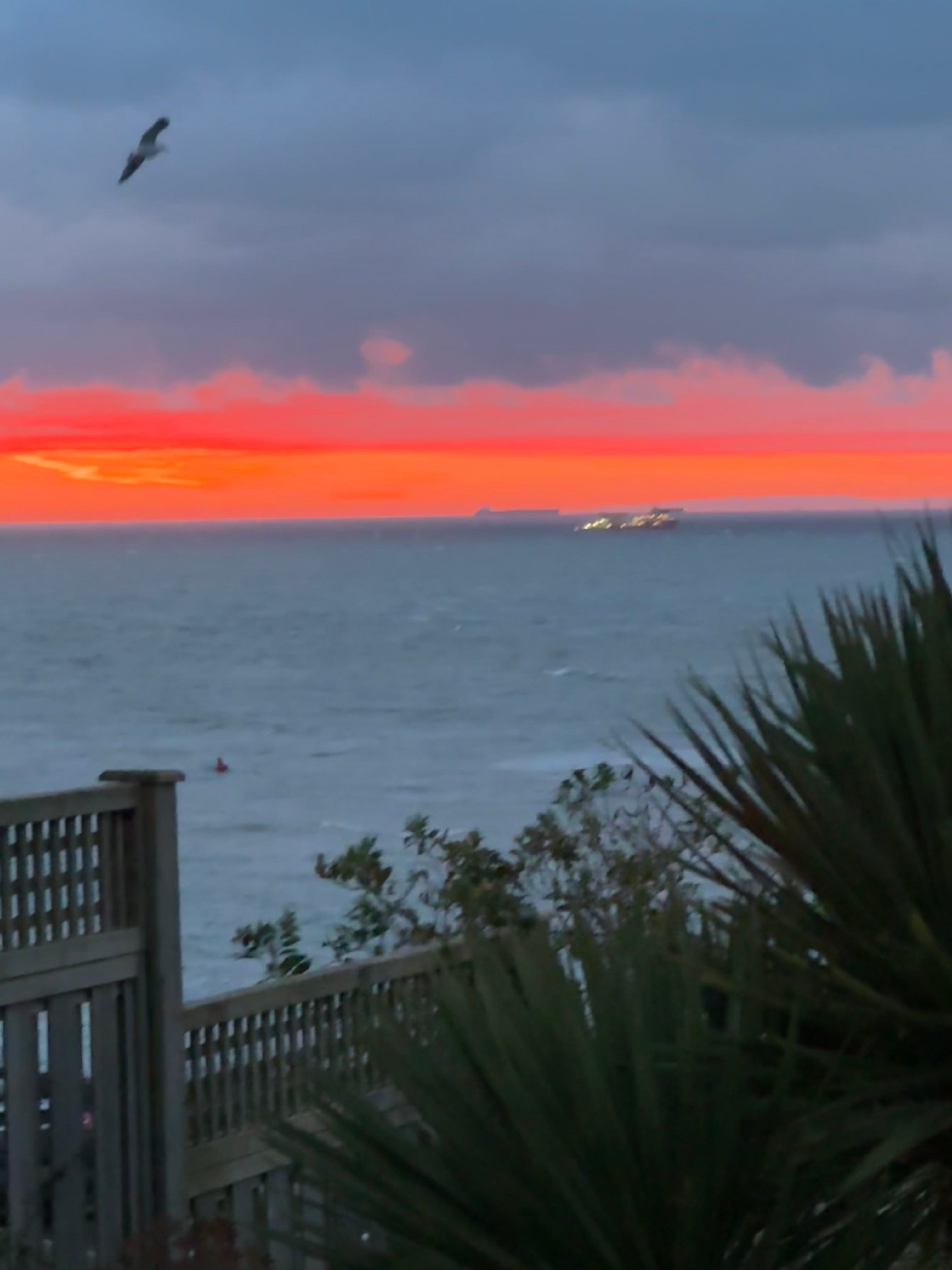
This morning, making tea for my wife before dawn, I looked out over the English Channel and saw a single band of red and gold fire between the grey of the sea and the winter cloud. Everything muted and vast — and then that insistent light refusing to be suppressed.
No kelp forest required. Just Folkestone, February, and not looking away.
The wonder doesn’t need to be taught. Only recognised.
Terry Cooke-Davies is a Distinguished Fellow of the Schumacher Institute. Recognition Theory: Schumacher Institute Briefing 1 (ISBN 978-1-0369-6925-7) is available from the Institute. He writes regularly at insearchofwisdom.online and The Pond and the Pulse on Substack.
On the disconnect between science and story, consider C.P. Snow's "two cultures" analysis, of how people educated in sciences and people educated in the humanities have a gap of understanding. Of his particular concern: That those telling stories understand little of science, and what hopes it affords us, so largely craft pessimistic tales, while those from science's side, understanding little of the humanities, fail to bring depth to their own accounts. In the climate crisis we see this in the broad production from the humanities (and our popular cultures) of stories of civilization's pending collapse, with very few stories where we harness ongoing advances in knowledge to turn back the crisis.
If stories are our motivations, ways of forming pictures of what we may subsequently long for and act towards, we may do well to take the risk of cultivating more non-ironic utopian visions, to stand as alternatives to our myriad tales of doom where our world goes off the cliff. In these stories, we may more fully weave the hopes and fears which the sciences bring to us into the dreams by which we fuel our desires and acts, and heal the gap between the scientists and the story tellers while, just perhaps, saving the world.
In order to fully let go of various mental systems, hierarchies and knowlwdge, however precise, I recommend contacting with Nature on a beautiful spring day by using the help of psychedelic mushrooms. Through this challenging initiation, the mushroom will SHOW you that it's all about relationships not knowledge, that we evolve as One. 🙏🏼♥️